
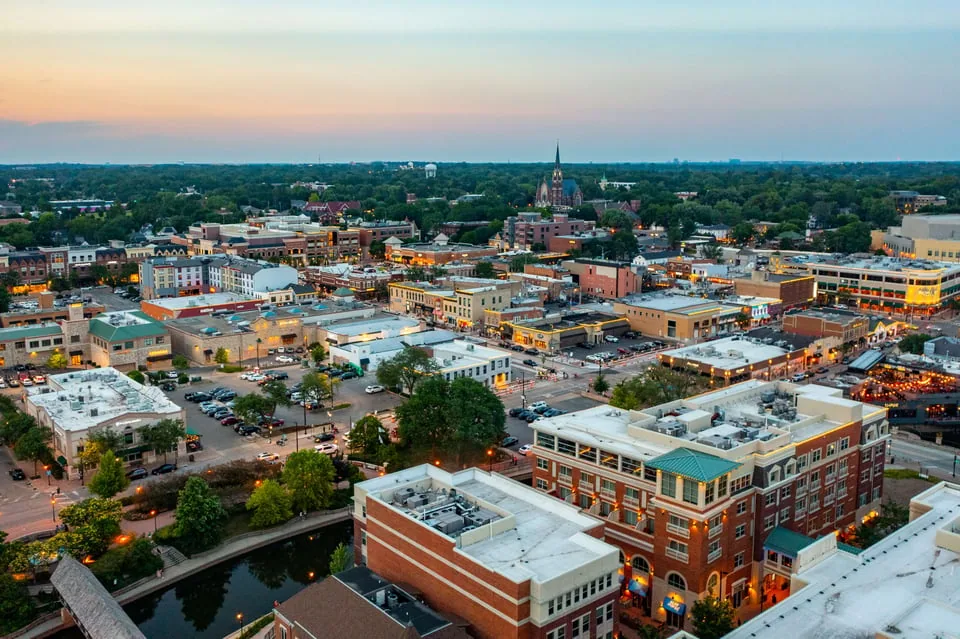
Commercial Roofing at Seven Bridges, Woodridge, IL
A split at a roof-to-wall termination can let water behind the flashing before a ceiling stain appears. At Seven Bridges in Woodridge, within the Naperville, IL service area, we locate that junction and check its support, height, and connection to the field membrane. The development combines offices, shops, restaurants, homes, recreation, and walking paths. Before a roof visit, the property manager identifies which entrance, tenant hours, and public paths must remain open.
Seven Bridges sits at Route 53 and Hobson Road in Woodridge. The reported location points us toward the property, but the roof plan and field walk establish the access route and assembly. We mark each visible transition, drain, equipment curb, and previous repair, then connect those observations to the leak report. The manager receives an inspection order that explains what to test before choosing repair or replacement.
A termination needs more than a surface bead
A roof-wall termination depends on flashing height, secure attachment, and a transition that sheds water without leaving an exposed edge. We inspect the termination from the field membrane up to the wall, then check corners and nearby penetrations. If metal or membrane has moved, sealant may close a surface gap but cannot restore the attachment underneath. Our roof inspection identifies the component that failed and the adjacent area that can accept a repair.
Mixed use adds a scheduling step. A shop entrance may be busy while an office roof needs access, and a walking route can run beside the lift or material path. We work with the manager to set a protected zone, choose the lift position, and confirm whether the repair can be isolated from residential access. A daily close-in point is set before work starts so an open junction is not left exposed during a change in tenant activity.
A reported event guides inspection order
The National Weather Service’s June 20, 2021 surveyed EF-3 tornado path crossed Naperville, Woodridge, Darien, Burr Ridge, and Willow Springs. A property manager can include the event date in a post-storm request; the inspection still tests the address and roof details directly. We look for lifted edges, displaced flashing, damaged equipment supports, punctures, and debris impact, then photograph any condition requiring a repair.
The National Weather Service also documented 1.5-inch hail in Naperville on May 27, 2019. The report documents hail in Naperville on that date; it does not document damage at Woodridge properties. If a property has a hail concern, we inspect the actual membrane, metal, coatings, and rooftop equipment for marks or functional damage. A hail damage assessment records the observed impact and distinguishes cosmetic marks from a detail that affects water shedding or attachment.
Drainage directs the next test
At a mixed-use development, a roof drain may serve a larger roof area than the tenant space where water appears. We inspect the strainer, bowl, flashing, nearby seams, and visible slope toward the outlet. If water remains after a storm, the cause could include debris, a blocked connection, or a low section. We document the outlet and test the adjoining details before recommending a repair. The drain and scupper review links the drainage finding to the roof section that needs follow-up.
A ponded area can also expose a weak seam or unsupported flashing to longer water contact. We compare the water line with the roof plan and previous repair notes, then confirm whether an outlet or surface correction is part of the approved scope. If the roof is split into tenant or ownership areas, the manager clarifies who controls the drain and who can authorize a test. A clear point of responsibility prevents the repair from stopping at the edge of a lease boundary.
Test the receiving sheet first
A prepared sample helps show whether a repair material can adhere or weld to the surface at the selected location. We clean the test area, follow system requirements, and record how the sample behaves. A successful test near one transition does not establish the condition of another roof section. If field markings or installation records identify PVC, our PVC detail repair follows compatible seam and flashing methods for that assembly.
If the sample lifts with old coating or membrane, we look for moisture, contamination, movement, or a weak substrate before expanding the patch. Our repair scope names the section, preparation, compatible material, and verification step. If water entry continues outside the prepared area, the manager can approve moisture testing before the roof is closed. This makes the repair boundary explainable in the work record.
Separate public paths from roof access
Seven Bridges includes walking trails and recreational use alongside offices, shops, restaurants, and residential areas. We plan protection for the active path and the work route separately. The property contact identifies hours with heavier pedestrian use, delivery windows, accessible entrances, and any event schedule that changes staging. We can use a controlled lift area or hand-carry route only after the manager confirms it suits the building and current site rules.
The job sequence should also protect occupied interiors from dust, water, noise, and material handling. If a repair is above a restaurant or residence, we coordinate notice and temporary protection with the person who controls that area. A phased occupied-building project lists which section opens and when it must be watertight. The manager receives the daily status and the next access requirement before the crew changes zones.
Repair and replacement follow different evidence
Repair fits a localized failure when adjacent membrane, flashing, and substrate remain sound enough for a compatible correction. Replacement deserves review when damage crosses multiple transitions, wet insulation extends beyond the first test, or several repairs have altered the same field. A replacement assessment documents the roof sections, deck, insulation, attachment, edges, drainage, and equipment curbs that drive the scope.
The property’s mix of businesses and homes does not decide which system belongs on a roof. We identify the existing assembly and compare restoration, recover, and replacement only when condition, code, and project requirements support those paths. For future oversight, a photo-indexed condition report can map the recommendation to a roof location. The owner can then match approvals and tenant coordination to the repair boundary rather than a broad district description.
Bring the reported detail to the visit
Share the address, roof plan, reported room or exterior junction, previous repair notes, and the manager who can provide access. Identify which shop, office, residence, or public path must remain open during the assessment. We can mark a test location, stage materials, and document any route restrictions before scheduling. If the reported condition follows a storm, include the date and any photographs that show when it appeared.
For active water entry, emergency response is available all day and night, including weekends and holidays. The first visit protects the affected area and records the roof finding that informs permanent work. A separate property in Woodridge needs its own inspection; Naperville buildings need the same address-specific review. Send the roof plan and access contact, and we will set an inspection order that preserves a clear closeout.
Commercial Roofing Questions
Does the 2021 tornado prove that this roof was damaged?
No. We use the reported path to guide the inspection request, then document the conditions at the specific property.
Can you tell a roof-wall leak from the ceiling stain?
The stain does not locate the entry by itself. We inspect termination height, attachment, nearby seams, and the path water could take.
What do you check after a hail report?
We inspect the roof material, metal edges, coating, curbs, and equipment, then record impacts that affect function or the repair scope.
How is repair separated from replacement?
We compare the test result, surrounding sheet, moisture, deck, drainage, and repeated repair areas before recommending a boundary.
Can a roof project keep walking paths available?
We coordinate lift placement and protected routes with the property manager, then sequence work where the site can safely support it.